Pioneer Settlement History
While the Pioneer Settlement looks at the history of the region, the site has its own distinct and interesting history too.
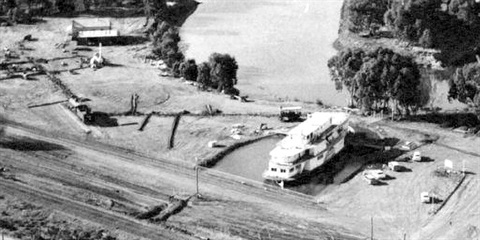
In 1962, Swan Hill community members and senior members of the State Government decided to explore the possibility of purchasing the PS Gem for Swan Hill to use as an art gallery, and as the beginnings of an open air, living history museum.
They planned to build a Mallee town to display their Gem and needed some buildings – and they got them. Some were donated by locals who wanted to help, others were built for specific purposes. Slowly a town grew – imitating the growth of the true towns of the Swan Hill region.
As the town grew, locals and visitors saw a possible home for their own loved but redundant items. At the same time, staff scoured the countryside – as far afield as South Australia and Queensland – for objects to help them get closer to their goal of recreating a lost, living past.
Horse drawn farming equipment was sourced and plans were soon afoot to follow overseas examples of growing crops and keeping livestock in the old fashioned way. Paddocks were fenced on Pental Island and machinery was demonstrated as the first step in that project.
Other large machinery like traction engines, tractors and stationary engines were also sourced, supporting the storyline of the development of the Mallee from wilderness to civilisation.
In 1966, the Swan Hill Folk Museum was ready to be opened to the public and they came, in ever increasing numbers. By the 1970s, the museum was one of the most popular tourism destinations in Victoria, if not Australia. People from around the country flocked to see what the people of Swan Hill had wrought at Horseshoe Bend on the Little Murray.
In 1970, the highest seal of approval was placed on the museum when Queen Elizabeth II came to see what all of the fuss was about. During this royal visit, with Prince Philip, Queen Elizabeth suggested the name be changed to Pioneer Settlement, and in 1971 the Swan Hill Folk Museum was renamed.
The Settlement introduced a new concept to Australian tourism, a concept that many would go on to emulate. The Pioneer Settlement would always be known as the first of its type in Australia.
Our Cobb & Co Royal Mail stagecoach, with the Paddlesteamer Gem in the background (Edit: April 1969, the first day the Cobb & Co. arrived at the Swan Hill Folk Museum. Driver Ted Edwards, unknown woman, and passenger Arthur Feltman, and at the rear bugler Dick Muston - with thanks to Robert Edwards). Freeman Cobb established Cobb & Co, with partners John Murray Peck, James Swanton, and John B. Lamber in 1853. At its 1870s peak, Cobb & Co coaches were travelling nearly 45,000km a week over 11,200km of routes from northern Queensland to southern Victoria. The last Cobb & Co stagecoach ran in August 1924. State Library Victoria: http://handle.slv.vic.gov.au/10381/4183329
(JPG, 390KB)
History or a cheeky yarn? We’ll let you be the judge... A June 1973 ‘Walkabout’ magazine article (p41-43), recounts a committee meeting with Victoria’s Premier Henry Bolte after the purchase of the PS Gem, with Councillor Ross Mellor outlining their plans for a folk museum, but “frankly, Sir Henry, we haven’t got the money to pay for it.” Sir Henry is said to have roared with laughter and exclaimed, “You cheeky b––!” and gave the committee $5,000. The PS Gem was purchased in 1962 for £4,000, decimal currency wasn’t adopted until 1966, the same year Henry Bolte would become a ‘Sir’ but he was nevertheless said to be very supportive of the project. Pictured: The Swan Hill Folk Museum, circa 1963.
(JPG, 242KB)